
Affordable Housing, Understanding the Difference between Workforce Housing and Low Income Housing
The Richards-Sinta Foundation — Housing & Wellness Series
Across the United States, housing costs have accelerated far beyond wage growth. While much public attention has centered on “affordable housing,” that term actually spans two distinct realities: low-income housing and workforce housing.
Both are essential to community health, but they serve different populations and rely on different financial models:
• Low-income housing provides a safety net for the most economically vulnerable
residents
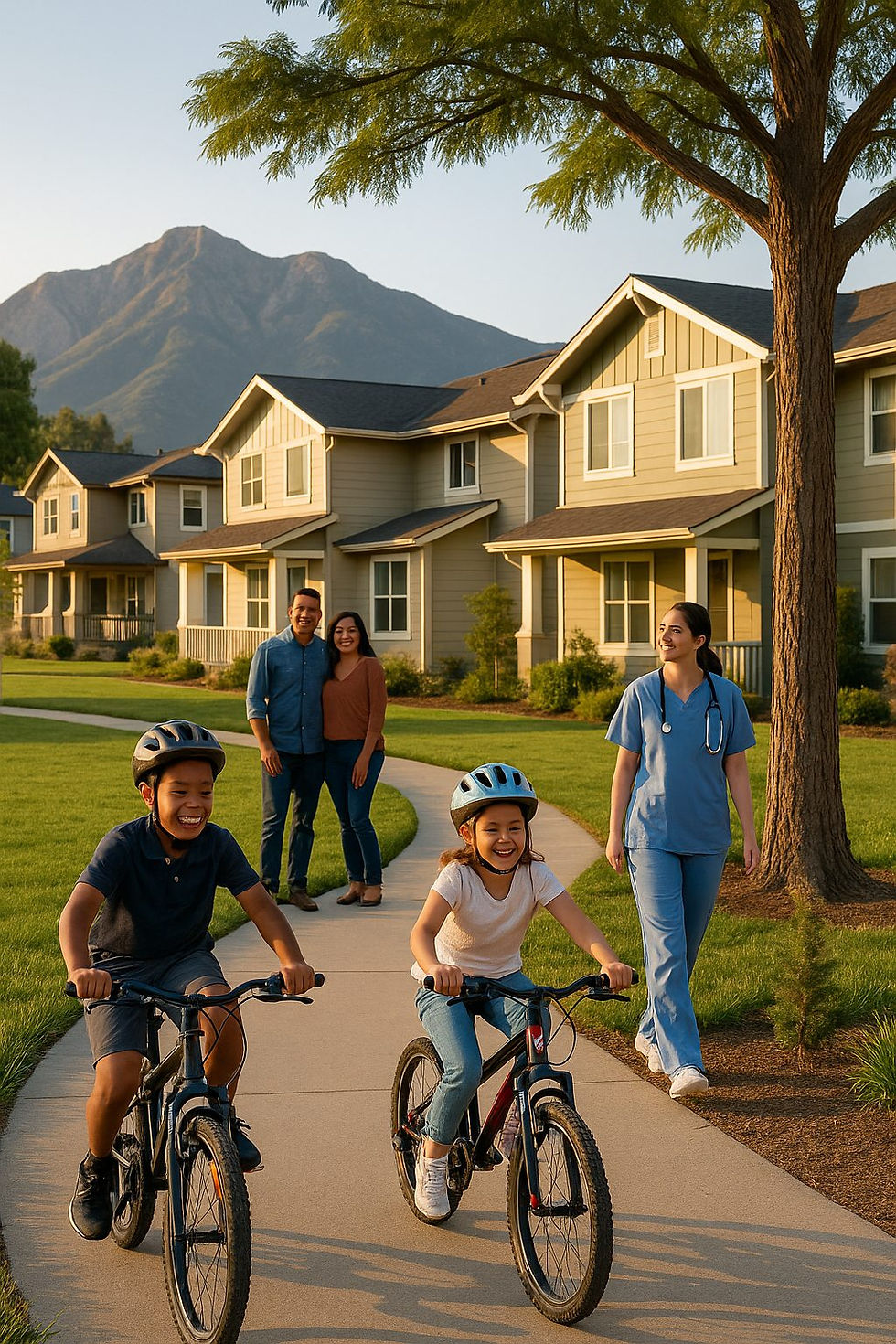
• Workforce housing provides stability for the working middle class—teachers, nurses,
first responders, and service employees who earn too much to qualify for government
subsidy but too little to live near their jobs
Understanding these differences is key to solving the modern housing crisis in a way that
preserves the character, economy, and wellbeing of America’s communities.
Why the need for Affordability distinction
Over the past decade, median home values in many U.S. regions have risen 150–300%, while
average wages have increased by less than 40%. Resort communities and high-cost metropolitan
areas—such as Steamboat Springs, Park City, and the San Francisco Bay Area—now face a
“missing middle” phenomenon: the essential workforce is priced out of the towns they serve.
The traditional tools of low-income housing, such as Section 8 vouchers and HUD-funded
developments, are not designed to meet this gap. Meanwhile, employers in education,
healthcare, and hospitality struggle to retain staff, and long commutes erode both productivity
and quality of life.
Low-Income Housing:
Low-income housing addresses acute poverty. It is primarily intended for individuals and
families earning below 50% of the Area Median Income (AMI) and often serves seniors,
disabled residents, or families living near or below the poverty line.
Key Characteristics:
• Income-restricted: Rent is typically capped at 30% of a tenant’s income.
• Government-subsidized: Funded by federal programs such as the Low-Income Housing
Tax Credit (LIHTC), Section 8, and local housing authorities.
• Managed and monitored: Nonprofits or municipal agencies ensure compliance with
complex income and reporting standards.
• Purpose: Provide long-term stability for those at risk of homelessness or displacement.
While critically important, low-income housing alone cannot serve the middle-income
households now facing displacement. Subsidies are limited, waiting lists are long, and
developments are often restricted to specific urban zones or redevelopment areas.
Workforce Housing: The Essential Middle
Workforce housing serves individuals and families earning roughly 80–120% of AMI. These are
working professionals who keep communities functional but find market rents or home prices
unattainable. This category is made up of teachers, police officers, firefighters, nurses, small business owners, retail employees, hospitality workers, construction staff, and resort employees.
Key Characteristics:
• Moderate affordability: Typically priced at 70–80% of local market rates, not linked to
income but to market moderation
• Limited or no subsidy: Financed through public-private partnerships, employer
collaborations, municipal incentives, or philanthropic foundations like R-SF
• Integration, not isolation: Developments are often mixed-income, located near schools,
hospitals, and downtown corridors
• Focus on community continuity: Enables workers to live where they serve, reducing
commute times, vehicle emissions, and staff turnover
Without workforce housing, towns lose the people that form their social fabric. Hospitals face
staffing shortages. Schools lose teachers. Restaurants and hotels operate understaffed. Resorts
are unable to maintain normal operations and grow.
The community character erodes as essential workers become commuter-based, and the
municipality becomes bifurcated into part time residents and short-term vacation renters.
Why the Distinction Matters
The phrase “affordable housing” can obscure the needs of different populations. Policymakers
and funders who fail to distinguish between low-income and workforce housing risk
misallocating resources.
For example, a resort community might meet its “affordable housing” requirement by funding
low-income units, yet still lose its teachers and nurses to neighboring counties. Similarly, a
hospital might offer signing bonuses rather than solving the root issue: housing affordability for
middle-income professionals.
By defining workforce housing as its own category—distinct from subsidy-dependent low income
programs—foundations, developers, and municipalities can target creative financing
tools that restore balance and inclusion.
At The Richards-Sinta Foundation (R-SF), workforce housing is not only an economic
issue—it is a public health and community wellness issue.
When people live where they work, they:
• Sleep longer, commute less, and participate in their community
• Engage more in civic and community affairs
• Experience better mental health, social connection, and family welfare
• Contribute to a stable local tax base that supports schools, parks, and public services
R-SF’s Workforce Housing Initiative is designed to:
• Partner with municipalities to identify local needs and zoning solutions.
• Support mixed-income developments that balance affordability with design quality.
• Integrate environmental stewardship, with energy-efficient construction and solar
microgrids
• Promote health-centric design, including walkability, and access to nature
• Preserve affordability through deed restrictions and long-term ownership models
Conclusion
Low-income housing and workforce housing are both critical pillars of a balanced housing
ecosystem. However, they serve fundamentally different groups and require distinct funding,
design, and policy frameworks.
When the workforce is forced to leave, the community character erodes as essential workers
become commuter-based, and the municipality becomes bifurcated into part time residents and
short-term vacation renters.
By investing in workforce housing, communities can protect the very people who keep them
alive—teachers, nurses, public employees, and service staff.
For RSF, this is not simply a housing initiative—it is a commitment to sustainable, healthy, and
inclusive living. The Foundation’s mission is to ensure that everyone who contributes to a
community can afford to be part of it.
The Richards-Sinta Foundation


Comments